

From well to pump: how fuel prices are formed
31 July 2026
By Friderike Kuik, Eliza Lis, Christiane Nickel and Mario Porqueddu[1]
Retail fuel prices have surged in 2026 following the outbreak of the conflict in the Middle East, driving up euro area energy inflation. In this blog, we examine the factors that drive fuel price dynamics at the pump.
Rising oil prices amid the conflict in the Middle East have put the public spotlight back on fuel costs and their potential impact on inflation. This blog post explains how changes in crude oil prices feed through to what consumers pay for petrol or diesel at the pump. To do so, we take three steps.
First, we break down prices into three components − crude oil, refining and distribution margins, and taxes − and show how these prices reacted to changes in oil prices within weeks and the pass-through was complete. Second, we explain why a 10% increase in oil prices does not automatically translate into a 10% increase in fuel prices, as taxes and other fixed cost components dampen the pass-through. And third, we examine the role of refining margins, which can at times amplify the impact of oil price shocks on fuel prices, household budgets and inflation.
Oil price rises are transmitted fast and fully to retail fuel prices
In general, the prices for refined fuel and crude oil move pretty much in lockstep from month to month, although refined products (in particular diesel) have outpaced crude at times since 2022. This is a first sign of the role played by refining margins, to which we will return later.
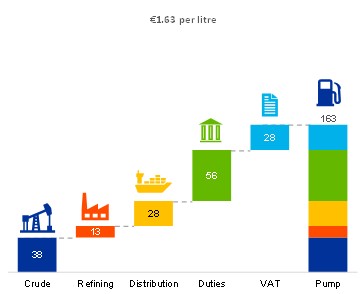
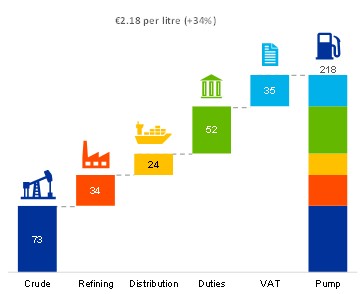
To better understand how the recent oil price shock made it to the price of diesel at the petrol station, we need to trace the transmission mechanism. Prices for Brent crude rose rapidly in March after the outbreak of the conflict in the Middle East, peaking at 138 US dollars per barrel in early April (Chart 1). This is almost double the level seen in late February. To produce diesel, crude oil is processed in a refinery. On this occasion, prices of diesel after the refining process rose even faster than prices of crude oil, peaking at 197 US dollars per barrel in April. This resulted in ever higher prices at the pump. By the first week of April, retail diesel prices averaged €2.18 per litre across the euro area compared with €1.63 per litre in late February – a sizeable jump of a third. Rising crude oil prices thus fed quickly into rising consumer prices, as they usually do. In general, the pass-through is fast, within one or two months, and complete. Rather than being absorbed by lower profit margins, an increase of €0.10 per litre in crude oil prices usually translates into an increase of €0.10 per litre in pre-tax pump prices.
While the pass-through from oil prices to pump prices is complete in levels, in relative terms retail prices increased less. To understand why, we need to look at all the other components that make up consumer prices. And this also helps us comprehend why diesel prices rose by €0.55 against only €0.35 for crude prices.
Chart 1
Developments in energy-related prices
a) Brent crude and refined petrol and diesel prices |
b) Petrol and diesel prices and HICP |
(US dollars per barrel) |
(index: 2025 = 100) |
|
|
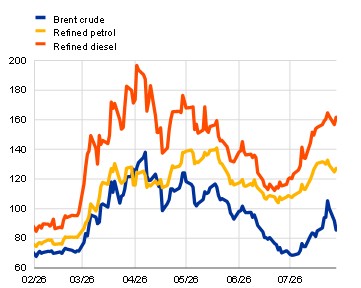
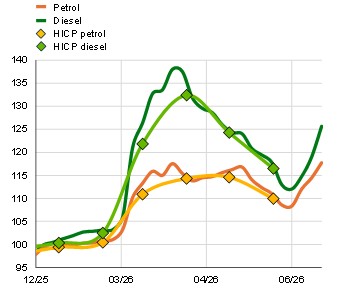
Sources: LSEG, European Commission and ECB calculations.
Notes: In panel a), the latest observations are for 28 July 2026. In panel b), the levels for petrol and diesel reflect the impacts of crude oil prices, refining costs and margins distribution costs and, margins, excise duties and taxes, derived from the European Commission’s Weekly Oil Bulletin (WOB). HICP stands for the Harmonised Index of Consumer Prices measure of inflation. The latest observations are for June 2026 for HICP inflation and the week of 20 July for diesel and petrol prices.
In relative terms, retail prices increase less than crude prices
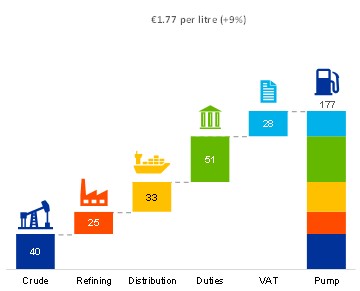
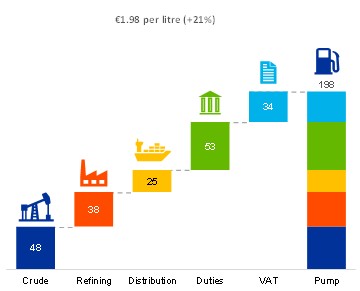
The prices of crude oil and refined diesel rose by over 90% between the end of February and the first week of April (peak since the outbreak of the Middle East conflict), whereas diesel prices at the pump increased by around “only” 34% (Chart 2, panels a and b).[2] Similar dynamics applied to petrol. The reason for this is that a large share of the retail price is fixed and does not move with oil market prices.[3]
Price elasticities – how much retail prices change in percentage terms when input prices change – vary along the five components that make up the price at the petrol station:
- Crude oil is highly sensitive to both supply shocks (like the Middle East conflict) and demand shocks (like the COVID-19 pandemic). Since 2021 the crude oil component has averaged around €0.47 per litre of diesel, ranging from €0.28 to €0.80. At its most recent peak in the first week of April, it reached €0.73 (a 92% increase compared with the end of February).
- Refining costs and margins are calculated as the difference between the contribution of refined product prices and the contribution of crude oil prices. This spread captures the additional costs and gross margins associated with all steps between crude oil arriving at the refinery and usable fuel leaving it. In the last week of February, they contributed €0.13 to the retail price of diesel, in line with the historical average from 2021. As mentioned above and detailed below, this price component was amplified during the recent energy shock (a 168% increase compared with the end of February).
- Distribution costs and margins cover all activities between refining and the final sale of the product. These include transporting the product to the local retail outlet, marketing expenses and the costs of operating the outlet (e.g. rents and wages). Distribution margins absorbed part of the increase in diesel refining, falling by 14% compared with the end of February.
- Excise duties are taxes levied at a fixed amount per litre that rarely changes, averaging €0.52 (diesel) and €0.66 (petrol) in the euro area since 2021. Several countries have temporarily cut excise duties to dampen the inflationary impact from the energy shock for consumers, as they did after Russia invaded Ukraine. These duties declined by around 8% compared with the end of February. In most cases, the latest measures expired in June this year.
- Value added taxes (VAT) are levied as a fixed percentage of the pre-tax consumer price and excise duties (currently around 19-22% in most countries). Thus, they rise and fall with the pre-tax price but add no independent volatility. VAT accounts for roughly one-sixth of the retail price. The VAT component increased by 24% compared with the end of February (hence less than the retail price percentage change due to a cut of around 8% to the average VAT rate across the euro area, from 20.7% to 18.9%).
As excise duties and VAT together make up a big, largely fixed share of the price, a given percentage increase in crude oil prices translates into a much smaller percentage move at the station.
The renewed escalation of the conflict since early July has pushed pump prices back up, to around €1.98 per litre of diesel in the third week of July – with refining margins again playing an important role (Chart 2, panel d).
Chart 2
The journey: before and during the shock
a) Retail diesel price in the last week of February |
b) Retail diesel price in the first week of April |
(cent per litre) |
(cent per litre) |
 |
 |
c) Retail diesel price in the last week of June |
d) Retail diesel price in the third week of July |
(cent per litre) |
(cent per litre) |
 |
 |
Sources: LSEG, European Commission and ECB calculations.
Notes: The retail price reflects the impacts of crude oil prices, refining costs and margins distribution costs and margins, excise duties and taxes in the euro area, derived from the European Commission’s Weekly Oil Bulletin (WOB). The percentage changes in pump prices shown in panels b), c), and d) are calculated relative to pump prices in the last week of February shown in panel a).
The latest observations are for the week of 23 February 2026 in panel a), the week of 6 April 2026 in panel b), the week of 29 June 2026 in panel c) and the week of 20 July 2026 in panel d).
Why refining margins mattered this time
What is behind the big jump in absolute prices for diesel and petrol? This time, refining margins made a difference.
These margins may vary for a number of reasons, including:
(i) the varying refining processes according to the refined product requirements and the type of crude oil used;
(ii) the varying supply of and demand for various refined products – for example, when refineries are closed for maintenance or damaged in conflicts, or also when refined products from specific countries are under embargo for political reasons.
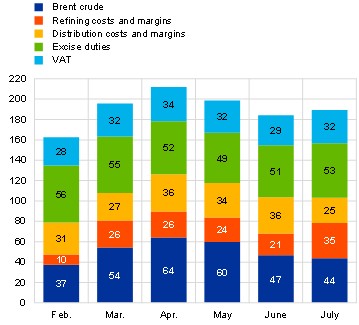
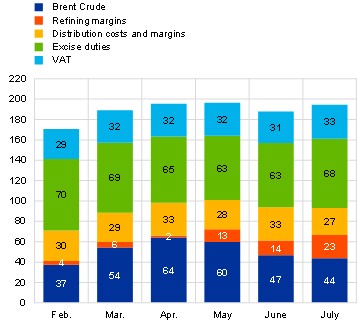
In the case of the recent energy shock, the closure of the Strait of Hormuz has affected a significant share of global refining capacity. Essentially, this led to a decline in global refined-product exports of around 4.5 million barrels per day in the second quarter of 2026.[4] This sharp supply crunch resulted in rapidly widening refining costs and margins, jumping from a monthly average of €0.10 per litre of diesel in February to €0.26 in March (Chart 3, panel a).
More recently, the renewed escalation of the conflict has led to another surge in refining costs and margins to near-record highs amid reduced refining capacity, contributing €0.35 to the diesel price and €0.23 to petrol for the first three weeks of July (Chart 3).[5] Looking ahead, based on refined diesel futures on 20 July, the contribution from margins is expected to peak in August before declining to €0.16 by the end of 2027, close to levels observed at the end of February 2026.
Chart 3
Decomposition of fuel prices in the euro area
a) Diesel |
b) Petrol |
(cent per litre) |
(cent per litre) |
 |
 |
Sources: LSEG, European Commission and ECB staff calculations.
Notes: Chart shows monthly averages. Refining and distribution costs and margins are calculated as the difference between pre-tax consumer prices and crude oil prices. The latest observations are for the week of 20 July.
What happens on the “way down”?
Crude oil prices fell significantly during the recent short-lived reopening of the Strait of Hormuz (18 June to 11 July), and retail diesel prices followed suit (Chart 2, panel c). Over the last few decades the “rockets and feathers” literature has discussed whether there is any evidence of asymmetry – whether retail prices fall less quickly (“feathers”) when oil prices come down compared with how fast they rise when oil prices go up (“rockets”). Earlier studies for the euro area failed to find any asymmetries or the overall picture was inconclusive.[6] However, more recent work suggests that the pass-through could be slower on the way down.[7] This could reflect lags in inventory replacement, uncertainty about the persistence of crude oil price changes or weaker competitive pressure when costs decline. Further analysis is therefore needed to establish whether and why asymmetries were observed during the recent shock.
Conclusions
The Middle East oil price shock has been significant and had a marked impact on retail fuel prices, with refining margins amplifying the effect. Overall, the Harmonised Index of Consumer Prices (HICP) for fuel drove the increase in the HICP for energy from -3.1% to 10.8% between February and May 2026 before it declined to 8.5% in June. As observed in the past, increases in the prices of crude and refined fuels passed through to retail prices rapidly, while temporary reductions in excise duties and taxes helped to alleviate the burden on consumers. When oil prices fell during the brief reopening of the Strait of Hormuz, pressures on retail fuel prices eased to some extent. The renewed escalation of the conflict has led to another sharp rise in fuel prices reflecting not only higher crude oil prices but also surging refining margins.
The views expressed in each blog entry are those of the author(s) and do not necessarily represent the views of the European Central Bank and the Eurosystem.
Check out The ECB Blog and subscribe for future posts.
For topics relating to banking supervision, why not have a look at The Supervision Blog?
Legal Disclaimer:
EIN Presswire provides this news content "as is" without warranty of any kind. We do not accept any responsibility or liability for the accuracy, content, images, videos, licenses, completeness, legality, or reliability of the information contained in this article. If you have any complaints or copyright issues related to this article, kindly contact the author above.
